System Out
This Action writes a message to the server_out.log file, located in the MFT Server installation\var\log directory.
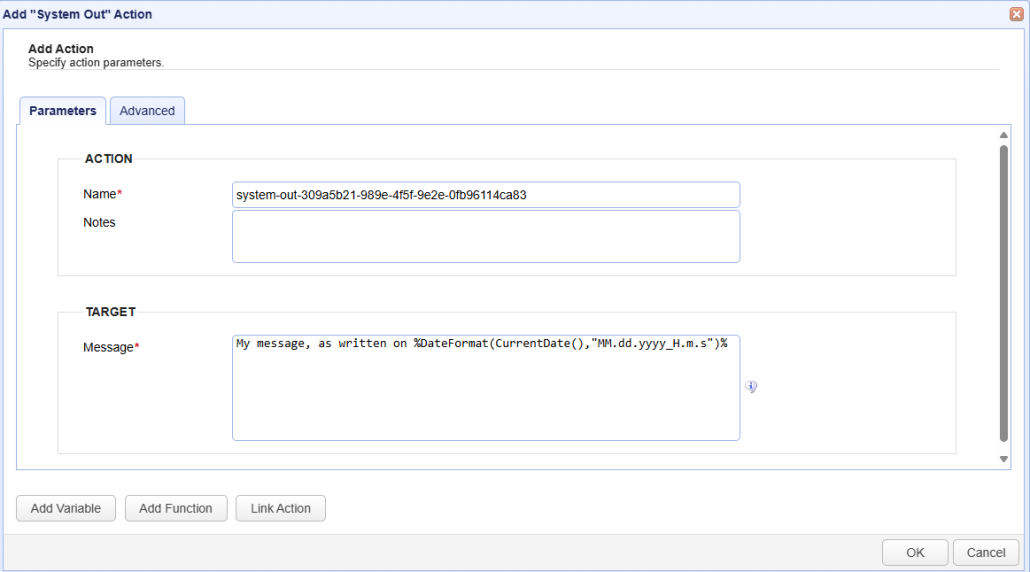
Parameters tab
ACTION
Name — Identifies the name of the Action. The system-generated default name, depicted in the image above, can be changed to a different name to suit your preferences. The Name must be unique within the current Trigger workflow.
Notes — Describes the Action.
The values in the Name and Notes fields are displayed in a tooltip when you mouse over an Action node.
TARGET
Message — Identifies the message to write to the
server_out.logfile, located in the MFT Server installation\var\log directory. If the file does not exist, it is created. If it does exist, the System Out information is added (appended) to the existing file.
System Out is typically used for the following reasons:
1. Troubleshooting (debugging). For example, you can add System Out Actions at different points in the Trigger workflow sequence. The message would reflect where the points are, like "Starting file transfer block" or "Condition A was met". You can also use System Out to output the current value of trigger variables. This is crucial for verifying that variables are being set correctly before they are passed to a subsequent Action. For example: "Processing file: %File%", where File is the name of the event variable.
2. Output the return value of prior Actions. For example, if you run a Directory Listing Action named directory-listing, the string the directory-listing returns can be used in the System Out
Messageas follows: %GetActionResult("directory-listing")%.
Not all Actions return a value.
3. As a final mention, you can use System Out when you have a function that you repeatedly use in the same Trigger Workflow. This would be similar to setting a runtime variable.
In the example image below, the following is set:
The System Out Action
Nameis: Filename_used_multiple_times_in_trigger.
The
Messagefield is: %GetGlobalVariable("FileName")%%DateFormat(CurrentDate(),"MM.dd.yyyy_H.m.s")%.txt.
A Global Variable is set in
AUTOMATION > Triggers > Settingsnamed FileName. See the image below that displays its value -c:\test1\Renamed_File_. GetGlobalVariable returns the value of this variable.
The DateFormat function returns the current day's date in the specified format.
When System Out runs, it returns the value of the GetGlobalVariable function and the Date functions, which in this example is c:\test1\Renamed_File_10.21.2025_14.22.44.txt.
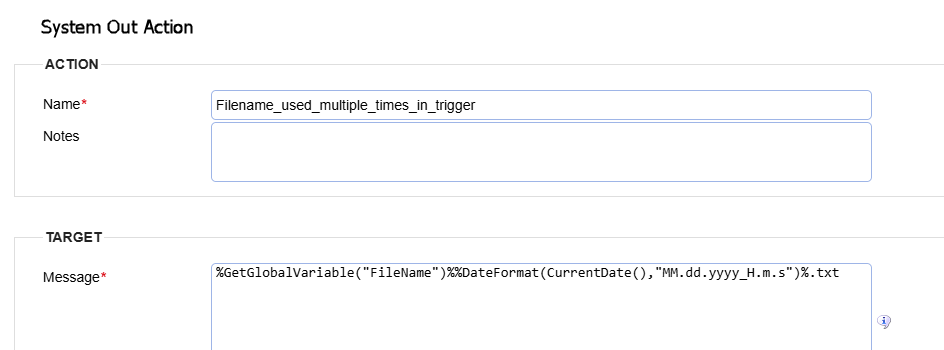

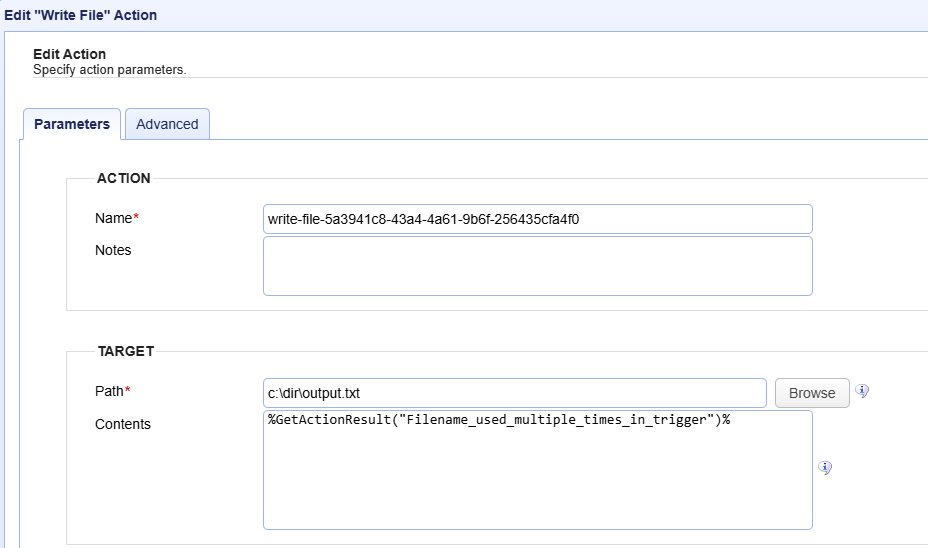
The return value of the System Out Action can be used by any subsequent Action that requires it. In the example below, the file name generated by System Out is stored and then passed to the Write File Action (where the file name itself is written to the output.txt file).
Using System Out to capture a value is optional. However, it reduces redundancy and improves maintainability by ensuring you only define the complex file name logic once. If you choose not to use System Out, you must repeat the entire file name expression: %GetGlobalVariable("FileName")%%DateFormat(CurrentDate(),"MM.dd.yyyy_H.m.s")%.txt in every subsequent Action field that needs it.
Advanced Tab
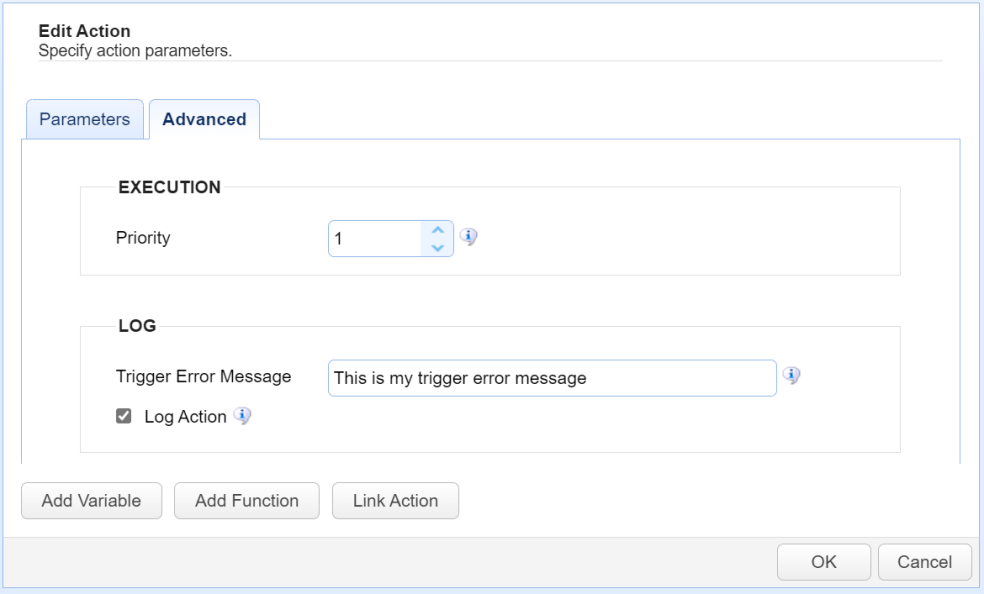
EXECUTION
Priority — Identifies the Action’s priority. An Action can be interrupted by an Action with a higher priority. The highest priority is 1. The maximum priority value is 1000. Priority comes into play when certain scenarios occur, like when Triggers or transfers are exceeded (see Settings for more information).
LOG
Trigger Error Message — Used when a Trigger Action fails. The two uses are described below.
The Trigger Error Message is displayed in the
Trigger Errorcolumn of the Action history (Triggers > History > View).
If you create an error-handling Trigger, the Trigger Error Message is passed to the error-handling Trigger.
An error-handling Trigger is a distinct Trigger that uses the
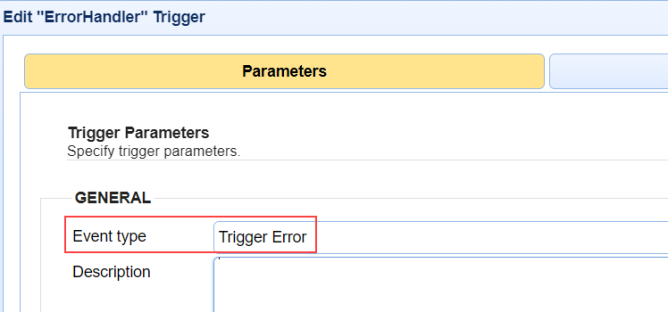
Trigger ErrorEvent type, as selected in theTrigger > Parametersdialog.If a Trigger Error event occurs, the Trigger Error Trigger runs.
The Trigger Error Message is accessible in the Trigger Error Trigger as a variable named TriggerErrorMessage.
The image below depicts the
Trigger Error Messagedisplayed in the history of a failed Trigger Action.

The image below depicts selecting the
Trigger ErrorEvent type used to handle Trigger errors.
The image below depicts a Trigger Action (part of the Trigger Error Trigger workflow) accessing a
Trigger Error Message. This is accomplished using the TriggerErrorMessage variable. To reference built-in variables, enclose the variable name in percent signs (%).

As a practical use case example, you can reference the
Trigger Error Messagein the body of an Email Action that is part of the Trigger Error workflow. The email alerts interested parties that a Trigger Action failed.Log Action — When selected, Trigger Action records are added to the
Domain > AUDIT > Loggingmodule. The state of the Action is included, such as action started, action completed, and action failed. When unselected, Action records are not added to the Logging module. However, the Trigger itself is still logged.
Buttons
Add Variable— Displays a list of built-in event variables. Each Trigger has several event variables you can use in one or more of the Trigger Action fields. When a variable is selected from the list, it is added to the Action field that is currently active. Built-in event variables are enclosed using the percent sign (e.g., %DomainName%).
In addition to using built-in variables, you can also specify a user-defined global variable, created in
AUTOMATION > Triggers > Settings. To reference a global variable ( Defining global variables), use the %GetGlobalVariable% function.
%GetGlobalVariable("DirName")% retrieves the global variable named DirName. When using global variables, specify the variable name enclosed in quotes, as depicted in this example.
Add Function— Displays a list of built-in functions. Functions are useful for formatting or parsing a Trigger event variable. When a function is selected from the list, it is added to the Action field that is currently active. For more details about functions and their usage, see Function types.
Link Action— Displays a list of Actions. When an Action is selected, the Action ID is returned.
An Action ID (a string of alphanumeric characters) is an input parameter used in the
GetActionResultfunction. This function returns the results of a previously executed Action in the current Trigger workflow. This means that Action results can be passed to a linked (following) Action.
TheGetActionResultfunction also supports using the ActionNameas an input parameter. This is an enhancement added in a more current version of MFT Server.Using Link Action
Select a field in the Trigger Action that you want to populate using the results of a previous Action.
Click Add Function. A list of functions displays.
Select GetActionResult(actionId). The field displays %GetActionResult(actionId)%.
Highlight the word
actionIdin the field.
Click Link Action. A list of Actions displays.
Select an Action. The actionId text is replaced with the Action ID.
The GetActionResult function looks similar to this: %GetActionResult("bee7cd8b-8021-4e19-8f76-1ae382e60c9d")%